
POVERTY IN AMERICA
It Doesn't Have to Be This Way
Paul Kruger, August 2026
Poverty doesn't always look like poverty.
It isn't necessarily homelessness. It isn't necessarily unemployment. It isn't necessarily an empty refrigerator or a person standing on a street corner asking for help.
Sometimes poverty looks like a couple sitting at their kitchen table after dinner, surrounded by bills, trying to figure out which ones can wait until the next paycheck.
- It can look like a working person who has a job but needs a second one.
- It can be asking your electric company for an extension so you can buy food.
- It can look like an older American trying to make a fixed income stretch another month.
- It can look like a family that owns a home but has no money left after the mortgage, utilities, groceries, insurance and car payment.
- And sometimes it looks like a household that is technically above the poverty line but is only one major car repair, medical bill, missed paycheck or rent increase away from serious financial trouble.
Poverty is not always about having nothing. Sometimes it is about not having enough margin to keep up.
Many don’t realize how close they are!
It’s not age related. Many elderly American’s live in poverty.
WHAT IS POVERTY?
|
The federal government has a formal definition of poverty. The Census Bureau compares a family's pretax money income with a poverty threshold based on family size and composition. By that measure, 35.9 million Americans—10.6% of the population—were living in poverty in 2024. That number matters but it doesn't tell the whole story. The Census Bureau also uses another measure, the Supplemental Poverty Measure, which considers things the official measure does not, including certain government benefits, taxes, work expenses, medical expenses and geographic differences in housing costs. The SPM poverty rate was 12.9% in 2024. |
 |
The two measures aren't competing definitions. They answer somewhat different questions.
And neither completely captures what it feels like to be financially vulnerable.
Three realities can overlap:
Official Poverty — Income below the federal poverty threshold.
Financial Insecurity — Income may be above that threshold, but there isn't enough financial cushion to absorb a serious setback. Being even a dollar over the threshold can foreclose some assistance.
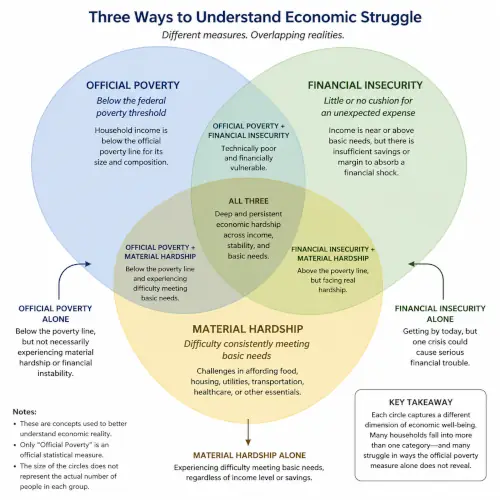
Material Hardship — A household has difficulty consistently meeting basic needs such as food, housing, utilities, transportation or healthcare.
These aren't three official government categories. They are a useful way of understanding the larger picture.
A person can be below the official poverty line and still manage to keep the household functioning.
Another person can be above it and be financially terrified.
The poverty line is a statistical boundary. Life doesn't recognize that boundary.
GETTING BY ISN'T THE SAME AS BEING SECURE
The Federal Reserve's household survey gives us a glimpse of the difference.
In 2024, 17% of adults said they had not paid all their bills in full during the previous month. Among adults with family income below $25,000, that figure was 34%. It fell to 23% for those earning $25,000–$49,999, 14% for $50,000–$99,999, and 7% for those earning $100,000 or more.
That is a relationship worth paying attention to.
As income rises, the likelihood of being unable to pay the bills falls sharply.
And the problem isn't simply whether someone can pay today's bills.
It's whether they can survive tomorrow's surprise.
- A broken transmission.
- A medical emergency.
- A lost week of work.
- A major appliance that dies.
- A rent increase.
- Costs of Utilities rise
- A child who needs something that wasn't in the budget.
These are ordinary events. What separates a financially secure household from a financially fragile one may be nothing more than the money available when one of them happens.
The Federal Reserve found that unexpected expenses most commonly involved major vehicle repairs or replacement, major house or appliance repairs, and unexpected medical expenses.
Some people don't discover how financially vulnerable they are until something breaks.
WHY DOES POVERTY EXIST?
There is no single answer.
Some poverty results from circumstances that are difficult or impossible to control. Disability, age, family circumstances, illness and unexpected personal events can all affect a household's ability to earn.
Some people make poor choices.
Some people lack motivation.
Some don't take advantage of opportunities available to them.
Those realities shouldn't be ignored.
But if we are asking what society can actually change, they aren't the entire story.
One of the first places to look is the paycheck.
THE PAYCHECK
A job is supposed to provide something more than employment.
It should provide enough income to allow a person to participate in ordinary life.
Work. Pay the bills. Feed the family. Keep a roof overhead. Get to work. Deal with life's surprises. Perhaps save something. Perhaps eventually buy a home.
But what happens when the paycheck increases while the cost of living increases faster?
And what happens when the economy becomes substantially more productive while worker compensation doesn't keep pace with that increased productivity?
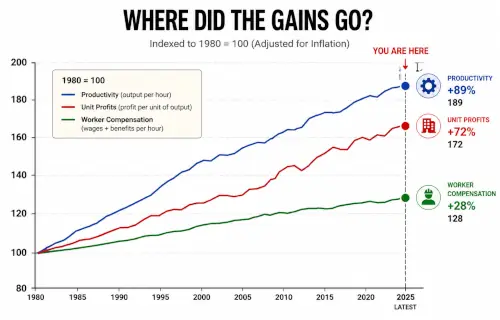
The Bureau of Labor Statistics measures labor productivity as output per hour worked. It also measures worker compensation and, for the nonfinancial corporate sector, unit profits.
The important question isn't whether businesses should make profits. Of course they should.
The question is simpler:
When workers and businesses are producing more value, how much of that additional value reaches the worker's paycheck?
A better machine can make a worker more productive.
Better software can make a worker more productive.
Better training can make a worker more productive.
Better methods can make a worker more productive.
A worker may simply get more done in an hour.
Whatever the reason, more output creates more economic value for employers.
That leads to a reasonable question:
Who receives the financial benefit of that additional value?
THE COST OF LIVING
A bigger paycheck doesn't necessarily mean a better life.
If the paycheck grows 20% but the things a family cannot avoid buying grow 30%, the family has lost ground.
- Housing.
- Food.
- Transportation.
- Utilities.
- Healthcare.
- Insurance.
Those aren't luxuries.
They are the things that allow people to live, work and function.
The Federal Reserve found that in 2024, 37% of adults said their monthly spending had increased from the previous year, while only 32% said their monthly income had increased. Sixty percent said changes in the prices they paid had made their financial situation worse.
That doesn't mean every household is getting poorer.
It means something more basic:
Rising income doesn't automatically translate into greater financial security.
WORKING AND STILL STRUGGLING
Perhaps one of the most uncomfortable facts in the poverty discussion is that having a job doesn't necessarily mean being financially independent.
A 2026 Government Accountability Office study found that an estimated 13.8 million adults enrolled in Medicaid and 10.6 million adults living in households receiving SNAP had worked during 2024.
About two-thirds of those workers worked full time.
Most worked for private-sector employers.
Many worked in transportation, restaurants and food preparation, and retail.
That isn't evidence that every low-wage employer is doing something wrong.
It is evidence of something we should understand:
Millions of Americans work and still need help meeting basic needs.
Where does the rest of the money come from?
- A spouse's paycheck.
- A second job.
- Savings.
- Credit cards.
- Family assistance.
- Public assistance.
Childcare can be another obstacle. Sometimes both parents need to work simply to make ends meet, yet the family still has to pay for someone to care for the children while they work. For lower-income families, that cost can consume a significant portion of the household's earnings.
- Or some combination.
- At some point we have to ask:
When does employment become enough to actually support a life?
WHO IS AFFECTED?
Poverty doesn't belong to one race, one age group, one occupation or one neighborhood.
But it doesn't affect every group equally.
The Census Bureau's data show significant differences in poverty rates among racial and ethnic groups, and the Federal Reserve finds differences in financial hardship by race, disability and income.
That doesn't automatically tell us why the differences exist.
And that distinction matters.
A disparity is a reason to investigate—not proof of a particular cause.
So we need to examine education, employment opportunities, wages, geography, family circumstances, discrimination, access to credit, housing and other factors before deciding what the numbers mean.
THE LOSS OF A BREADWINNER
A family can be financially stable until something happens to the person producing a substantial portion of its income.
- Incarceration can remove a breadwinner.(high cost of phone calls from prisons!)
- Deportation can remove a breadwinner from an American family.
- Disability can remove a breadwinner.
- A serious illness can do the same.
- The event may be sudden. The bills aren't.
- The mortgage or rent remains.
- The electric bill remains.
- The car payment remains.
- The grocery bill remains.
The children still need food, clothing and transportation.
This is one of the places where poverty can be created very quickly without anyone deciding to become poor.
HOUSING, HEALTHCARE, CREDIT AND DEBT
The paycheck doesn't operate in isolation.
A household's financial condition is shaped by what that paycheck has to accomplish.
- Housing can consume a huge portion of income.
- Healthcare can turn an otherwise manageable year into a financial crisis.
- Poor credit can make borrowing more expensive precisely when someone can least afford it.
- Debt can turn tomorrow's income into today's payment.
- And when money is tight, people frequently have fewer good choices.
- A person with savings can replace a broken car.
- A person without savings may need a loan.
- A person with good credit may get a manageable interest rate.
- A person with damaged credit may pay considerably more.
The same financial problem can therefore cost different people very different amounts.
Being poor can be expensive.
3. WHAT DOES POVERTY COST ALL OF US?
This is where the subject stops being somebody else's problem.
When someone cannot afford healthcare, there can be consequences beyond that person. Putting off routine care can allow relatively manageable problems to become emergencies. Those costs don't simply disappear when the patient can't afford the bill. They are absorbed somewhere else in the healthcare system.
When someone cannot afford reliable transportation, getting and keeping a job becomes harder. When a family cannot build savings, it cannot easily buy a home or accumulate wealth. When a person cannot develop skills because survival consumes every available dollar and hour, potential earnings can be lost.
Poverty also limits the ability to participate in the economy. Someone struggling to pay the electric bill isn't likely to be buying a new car, remodeling a kitchen or eating out regularly. Someone living paycheck to paycheck has little opportunity to save, invest or start a business. Multiplied across millions of households, those limitations affect businesses and communities as well as the people experiencing poverty.
And there is another important point: the cost doesn't necessarily stay with the person who is poor.
When a family cannot cover its medical expenses, someone else may eventually absorb part of the cost. When wages aren't enough to meet basic needs, public programs may fill part of the gap. When a person cannot afford transportation or childcare, the ability to work can be affected. When people cannot accumulate savings or property, the opportunity to build wealth is lost.
The cost of poverty can therefore show up in places that don't look like poverty at all.
Poverty can mean:
- Lost productivity.
• Lost earning potential.
• Lost tax revenue.
• Greater reliance on public programs.
• Greater healthcare costs.
• Less consumer spending.
• Less wealth creation.
• Opportunities that never happen.
The question isn't simply:
How much does poverty cost poor people?
It is:
What does it cost all of us when millions of Americans cannot fully participate in the economy?
And perhaps the most important part:
If poverty prevents people from contributing everything they could contribute, reducing poverty isn't simply helping people at the bottom. It is recovering some of the economic potential we are currently leaving unused.
HOW COULD WE FIX IT?
This is where we need to slow down.
We shouldn't begin with a political prescription.
We should begin with what the evidence tells us.
- If wages are inadequate, what would raise them without destroying jobs?
- If housing is unaffordable, what would make housing more attainable?
- If healthcare costs are pushing families into poverty, what changes actually reduce those costs?
- If education improves earning potential but leaves people buried in debt, how can we preserve the benefit without creating the burden?
- If people are working full time and still relying on public assistance, should we examine the wages, the benefit system, or both?
- If poor credit makes poverty more expensive, what can be changed without creating irresponsible lending?
- If particular groups face measurable employment barriers, what are those barriers—and which ones are actually institutional rather than simply differences in education, experience or circumstance?
These are questions worth answering.
And they deserve answers based on evidence rather than political slogans.
WHAT WE SHOULD NOT DO
- We shouldn't pretend everyone experiencing poverty is a victim.
- We shouldn't pretend everyone experiencing poverty simply needs to work harder.
- We shouldn't pretend government can solve every problem.
- We shouldn't pretend business is the enemy.
- We shouldn't pretend every disparity proves discrimination.
- And we shouldn't pretend every government program works simply because it has a good intention.
If we're going to propose changes, they need to survive scrutiny.
That means asking what a change costs, who pays, who benefits, whether it works and what unintended consequences it might create.
FOLLOWING THE MONEY
There is an old investigative principle:
Follow the money.
For this subject, that means following the money without deciding in advance where it will lead.
- When we see wages, ask where the money generated by the work goes.
- When we see rising prices, ask who receives the additional revenue.
- When we see public assistance, ask why it is necessary.
- When we see poverty, ask who bears its cost.
- When we see a policy, ask who benefits from it.
And then:
Follow the evidence.
Sometimes the answer will point toward business.
Sometimes government.
Sometimes markets.
Sometimes social conditions.
Sometimes individual decisions.
Often it will be some combination of them.
The purpose isn't to find someone to blame.
The purpose is to find something we can change.
POVERTY ISN'T INEVITABLE
America will always have some people who make poor choices but....
- People will become sick.
- People will become disabled.
- People will grow old.
- People will experience tragedy.
- People will sometimes fail.
- Those things are part of being human.
But that doesn't mean every circumstance surrounding poverty is inevitable.
- Some are the result of choices we make as a society.
- Some are the result of public policies.
- Some are the result of economic structures.
- Some are the result of institutions that can be changed.
If something can be changed, it deserves to be examined.
THE QUESTION WE LEAVE YOU WITH
Perhaps the most important question isn't:
Why are poor people poor?
It is:
Why can someone work, contribute, play by the rules and still struggle to afford the basic necessities of life?
And then an even bigger question:
If some of the barriers are things we created, why couldn't we create something better?
That doesn't mean there is a simple answer.
There probably isn't.
But there is a difference between a problem that is difficult and a problem that is impossible.
- Poverty in America is difficult.
- It doesn't have to be permanent.
- And it doesn't have to be accepted as inevitable.
- The first step isn't deciding what to believe.
- It's understanding what the numbers actually tell us.
- Then we decide what we are willing to do about it.
POVERTY IN AMERICA
It Doesn't Have to Be This Way.
RESEARCH NOTE
This article intentionally distinguishes official poverty from financial insecurity and material hardship, and it avoids treating homelessness as representative of the typical poverty experience.