
Iran War Part 1 of ?
The Cost of War Doesn’t End When the Shooting Stops
Paul Kruger August 2026
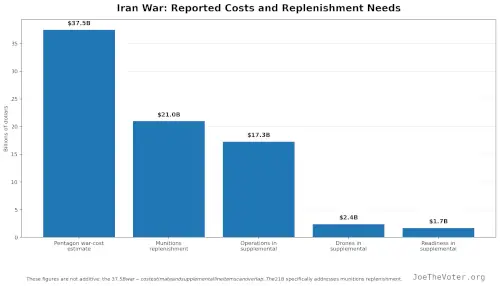
When Americans hear that a war has cost $37.5 billion, it is tempting to think of that figure as the price tag—and once Congress appropriates the money, the bill is paid.
It isn’t.
The Pentagon estimates that the Iran war has cost approximately $37.5 billion, with that estimate extending through the end of fiscal year 2026. The Pentagon has also requested $21 billion specifically to replenish munitions consumed during the conflict.
That distinction matters.
A missile fired in combat may have been manufactured years ago and already paid for. Nevertheless, the United States has consumed that asset. If military planners determine that the stockpile must be restored, taxpayers eventually have to finance its replacement. The same principle applies to destroyed aircraft and drones, damaged equipment, accelerated maintenance, spare parts, fuel, and other resources consumed by the operation.
The Cost That Doesn’t Arrive as a Government Invoice
There is another category of war cost that is easy to overlook because it does not arrive as a single weapons invoice: the continuing cost of putting people in harm’s way.
A service member deployed into a combat or imminent-danger area continues to receive normal military compensation, while the government may also incur additional costs associated with the deployment. Those costs include special pay, family-separation compensation, meals, travel, transportation, medical support, housing and other personnel-related expenses.
The 2026 military pay tables provide the basic pay received by active-duty personnel. For example, an E-5 with two years of service has basic pay of $3,342.90 per month, or about $111 per day before other allowances and deductions. Higher ranks and longer service produce higher basic pay. These figures are compensation to the service member, not the government's complete cost of employing that person.
There are also specific costs associated with dangerous and separated duty. The Defense Finance and Accounting Service states that Hostile Fire Pay or Imminent Danger Pay can provide up to $225 per month, with Imminent Danger Pay prorated at $7.50 per qualifying day. A service member exposed to a qualifying hostile-fire event can receive the full $225 monthly amount.
Family separation creates another direct obligation. DFAS currently lists Family Separation Allowance at $300 per month, prorated to $10 per day for qualifying periods.
Food and travel also have measurable daily costs. The Defense Travel Management Office's 2026 Government Meal Rate is $18 per day when the applicable government dining arrangement is used. Overseas travel can carry substantially higher authorized lodging and meal rates depending on location; for example, the 2026 maximum per-diem rate for Camp Arifjan, Kuwait, is $428 per day.
These individual allowances should not be added together as though every deployed service member receives every allowance. Eligibility depends on location, assignment, family circumstances and the nature of the duty. They do, however, illustrate something important: the cost of a deployed force continues every day that the personnel remain committed.
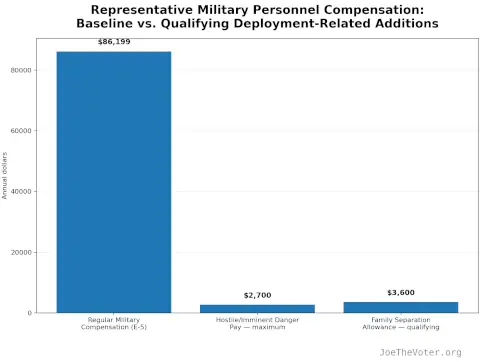 |
Editorial disclaimer — What We Know / What We Don't Know: This article does not claim to determine the complete personnel cost attributable specifically to the Iran conflict. The current administration and Department of Defense have not made all relevant information publicly available. The figures presented here are based on publicly available, independently verifiable information to the best of our ability. They establish a measurable baseline for the ordinary cost of military personnel and identify publicly documented additional compensation associated with qualifying deployment or combat duty. Where war-specific personnel costs, deployment numbers, medical costs, transportation, logistics, classified operations, readiness expenditures, or other relevant information are not publicly established, we do not manufacture a number or present an assumption as fact. |
At the Department-wide level, the FY2026 budget requested approximately $165.6 billion for active personnel costs, including the contribution to the Medicare-Eligible Retiree Health Fund. The direct active personnel cost before that retiree-health contribution was approximately $154.0 billion. Congress authorized 1,302,800 active-component personnel for FY2026.
Dividing the $154.0 billion direct active-personnel budget across the authorized active force produces a rough average of about $324 per active service member per day. This is not a war-specific cost and it is not the amount paid to an individual service member. It is a useful scale indicator of the government's average direct personnel cost across the active force.
The Iran conflict adds another layer: personnel who are deployed, operating aircraft and ships, maintaining weapons systems, providing intelligence and logistics, and supporting combat operations remain on the payroll and generate operating and personnel costs every day the mission continues.
For the individual service member, the cost is not simply financial. There is separation from family, exposure to danger, extended duty and the possibility of injury or death. For taxpayers, those human commitments translate into continuing personnel and support obligations that accrue day after day.
The energy and consumer-price effects are treated separately in Part Two, where the same timeline is used to examine oil prices, gasoline and energy prices, and the reported profitability of major oil companies. That separation keeps the direct cost of the military operation distinct from the broader economic effects that may follow from the conflict.
T he Second Bill: Interest
Then comes another bill: interest on the debt.
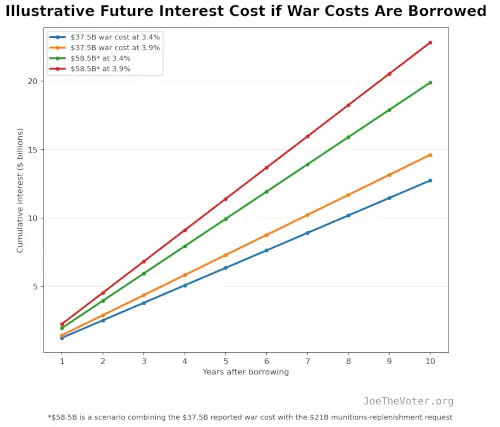 |
If the government borrows to pay for the war rather than raising taxes or cutting other spending, taxpayers don’t merely repay the original expenditure. They also pay interest on that borrowing. For perspective, CBO projects the average interest rate on debt held by the public to be about 3.4% in 2026, rising toward 3.9% later in its 2026–2036 projection. At a constant 3.4% rate, financing $37.5 billion would represent roughly $1.3 billion in interest per year. Over ten years, that is approximately $12.8 billion in simple interest alone if the principal remains outstanding. And that is before considering replacement of consumed munitions, equipment losses, repairs, or other long-term costs. Also consider that in today’s dollars, replacement costs will be far greater than the original cost to build current stocks. |
The Real Cost Has a Tail
The economic cost of war therefore doesn’t necessarily end when the shooting stops.
Taxpayers can pay when the government spends the money, pay again when military stockpiles must be rebuilt, pay interest on the borrowing used to finance those expenditures, and continue paying the personnel and support costs for as long as the military commitment continues.
Some of those costs can be measured directly.
Some can be estimated.
And some—such as how much of a price increase becomes additional corporate profit—must be investigated through company-level financial data.
That is why looking at the entire timeline matters.
The question isn’t simply “How much did the war cost the government?”
It is:
“How much did/will the war ultimately cost Americans?”
------------------------ Distribute freely with attribution ------------------ JoeTheVoter.org ------
Sources:
- Department of Defense, FY2026 Military Personnel Programs.
- Defense Finance and Accounting Service, 2026 Military Basic Pay Tables.
- Defense Finance and Accounting Service, Hostile Fire / Imminent Danger Pay.
- Defense Finance and Accounting Service, Family Separation Allowance.
- Defense Travel Management Office, 2026 Government Meal Rates and Overseas Per Diem Rates.
- Congressional Research Service / Congress.gov, FY2026 Active Component End Strength.
- Graphs prepared by author with the use of AI