
The IRAN War!
When the Price Shock Becomes an Opportunity or profit.
Paul Kruger August 2026
Energy deserves special attention in this time of “war” because oil is not simply another consumer commodity. It is an input into transportation, manufacturing, agriculture, shipping, plastics, chemicals and the distribution of virtually every physical product sold in the United States.
Consequently, a major oil-price shock can spread through the economy.
The Iran war coincided with a major oil-market shock. Brent crude averaged roughly $64 per barrel in the final quarter of 2025. By the second quarter of 2026, the quarterly average had risen to approximately $103 per barrel. The EIA reported that disruptions in Middle Eastern oil supply and transportation through the Strait of Hormuz contributed to the higher prices and stronger U.S. refining margins.
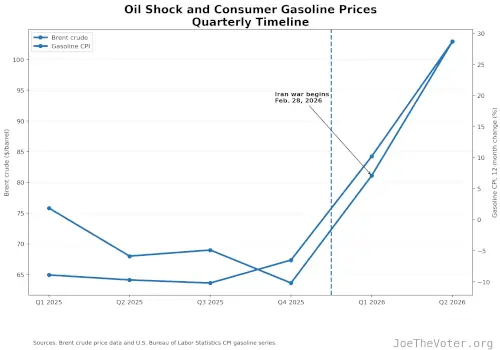 |
The effect reached consumers. The Bureau of Labor Statistics reported that gasoline prices were 40.5% higher than a year earlier in May 2026 and energy prices were 23.5% higher. By June, the year-over-year increases had moderated to 26.7% for gasoline and 15.7% for energy, but prices remained substantially above the previous year’s levels. There is an important distinction here. The existence of a war-related oil shock does not mean that every dollar of higher gasoline or food prices was caused by the war. Oil prices respond to many factors, and companies throughout the supply chain make independent pricing decisions. The timing of the price movement is therefore evidence of a relationship worth examining, not by itself proof of causation. |
But a supply shock can create something else: an opportunity for margins to expand.
If a company's relevant costs rise by 20% and it raises its selling price by approximately the same amount, its margin should remain broadly stable, all else being equal. In a vertically integrated oil company, however, company-wide net margin is affected by many businesses and factors, so it is an indicator rather than a direct measure of gasoline or refining margin.
If its costs rise 20% but its selling price rises substantially more, the difference can appear as increased margin.
That is why looking only at the price of crude oil is insufficient. We also need to look at what happened to the companies selling the resulting products.
The Margin Test
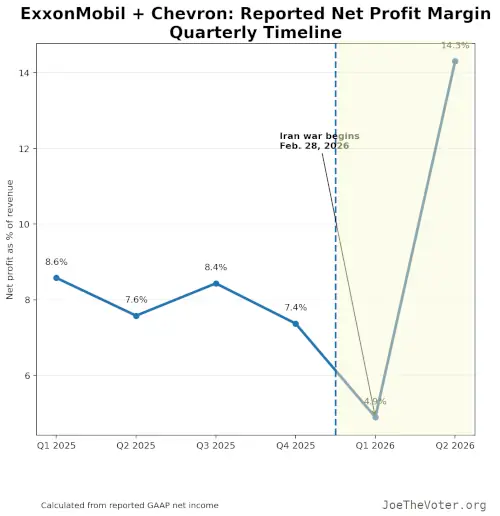 |
The second graph compares the combined reported net profit margin of ExxonMobil and Chevron over the same period. This is a company-wide measure, not a direct measure of gasoline or refining margin. The change is striking. In the second quarter of 2025, the two companies together earned approximately $9.6 billion on roughly $126.3 billion of revenue—a net margin of about 7.6%. In the fourth quarter of 2025, the combined margin was approximately 7.5%. The first quarter of 2026 was actually weaker, at approximately 4.9%. Then came the second quarter—the first full quarter following the February 28 start of the Iran war. ExxonMobil and Chevron together reported approximately $26.6 billion in GAAP earnings on roughly $186.1 billion of revenue, producing a combined net margin of approximately 14.3%. Exxon alone reported $14.525 billion in earnings, while Chevron reported $12.1 billion. |
That does not establish that either company engaged in illegal or improper profiteering.
It does establish something considerably more useful for analysis:
Their combined net margin was about 1.9 times the level seen in the same quarter of the previous year.
And the companies themselves identify market conditions as part of the explanation. Chevron reported that its second-quarter earnings increased because of higher commodity prices and higher margins on refined-product sales. It also reported that international downstream earnings benefited from higher refining margins amid Middle East supply disruptions. Exxon reported that its upstream earnings and energy-products earnings improved substantially during the quarter.
Reuters likewise reported that the Iran conflict and resulting supply disruption helped drive higher refining margins and the major companies’ unusually strong earnings.
The important question therefore isn’t whether the companies were allowed to make a profit. Of course they were.
The question is whether the amount consumers paid increased substantially faster than the relevant underlying costs required to provide the product.
If companies merely passed their higher costs through to consumers, we would generally expect their margins to remain relatively stable, all else equal.
When margins expand substantially during the same period that consumers are experiencing a major price shock, the expansion itself becomes something that can be felt, measured, investigated and discussed. It does not, by itself, establish that the entire margin increase came from consumer fuel prices or from the Iran conflict.
That is the difference between alleging profiteering and presenting evidence that raises a testable question: how much of the price increase reflects higher underlying costs, and how much reflects expanded corporate margins?
------------- Distribute freely with attribution ------------------
Sources:
- U.S. Bureau of Labor Statistics — Consumer Price Index-https://www.bls.gov/cpi/?utm_source=chatgpt.com
- U.S. Energy Information Administration — Petroleum & Other Liquids-https://www.eia.gov/petroleum/?utm_source=chatgpt.com
- Federal Reserve Bank of St. Louis — FRED-https://fred.stlouisfed.org/?utm_source=chatgpt.com
- ExxonMobil — Investor Relations / Financial Results-https://investor.exxonmobil.com/?utm_source=chatgpt.com
- Chevron — Investor Relations-https://www.chevron.com/investors?utm_source=chatgpt.com
- Reuters — Trump blasts Exxon, Chevron over profits-https://www.reuters.com/business/energy/trump-demands-lower-gas-prices-oil-companies-chides-chevron-ceo-2026-08-03/?utm_source=chatgpt.com
- Reuters — Top U.S. refiners see profits soar-https://www.reuters.com/business/energy/top-us-refiners-see-profits-soar-step-up-investor-rewards-2026-08-12/?utm_source=chatgpt.com
- Reuters — Iran, gasoline prices and the Strait of Hormuz-https://www.reuters.com/world/us/trump-urges-americans-accept-higher-gas-prices-he-escalates-iran-rhetoric-2026-08-14/?utm_source=chatgpt.com
- Reuters — Oil prices and Strait of Hormuz disruption-https://www.reuters.com/business/energy/oil-set-weekly-gains-after-us-threatens-indefinite-blockade-iran-2026-08-14/?utm_source=chatgpt.com
- Los Angeles Times — Chevron and ExxonMobil profits amid Iran war-https://www.latimes.com/business/story/2026-08-03/chevron-exxon-mobil-reap-massive-profits-as-iran-war-drives-up-energy-prices?utm_source=chatgpt.com
- Graphs produced by author using the cited public data sources. The ExxonMobil/Chevron graph uses combined GAAP net income divided by combined quarterly revenue; this is a company-wide net margin and should not be interpreted as a direct gasoline/refining margin.
- https://joethevoter.org